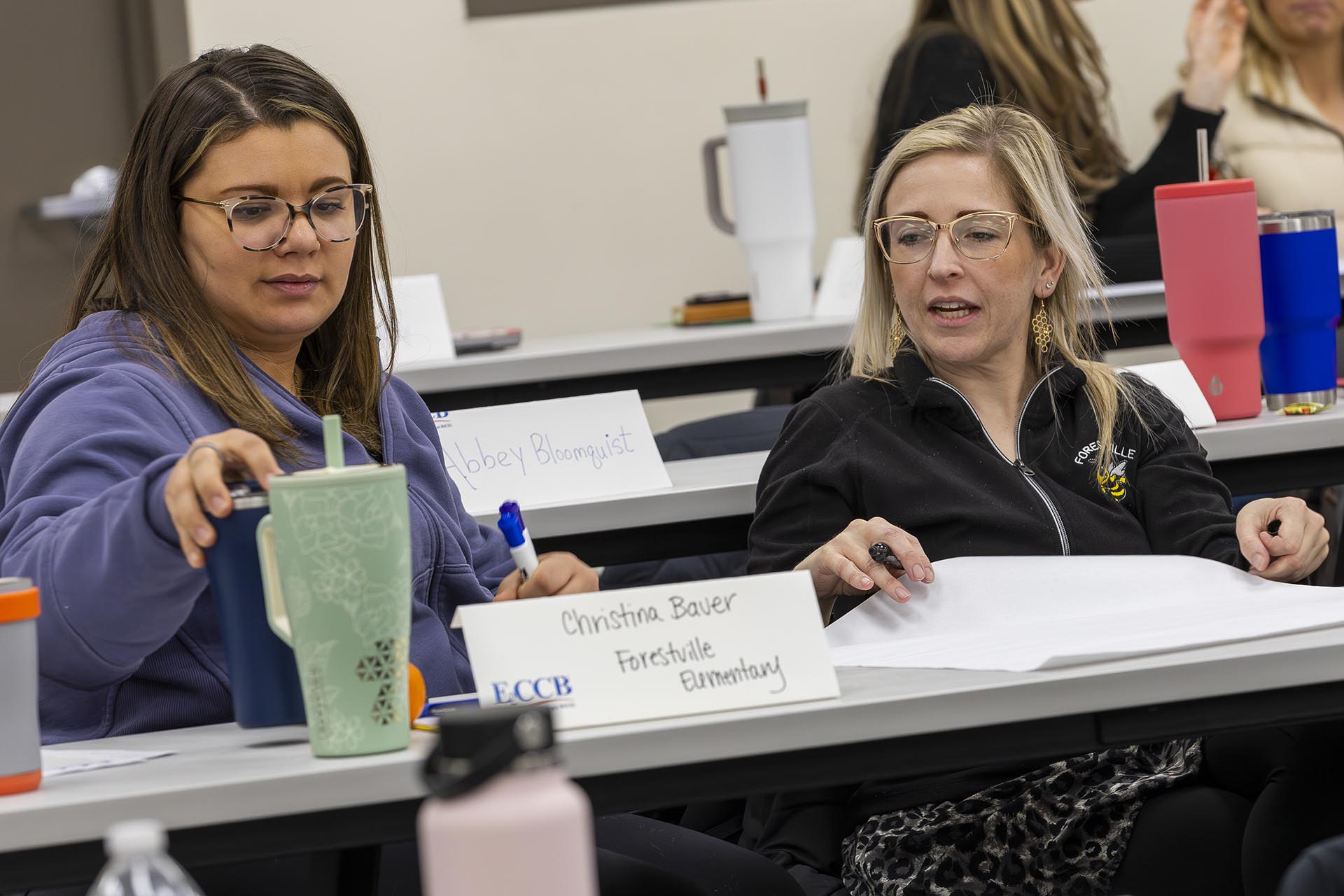

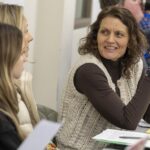
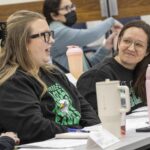
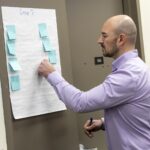
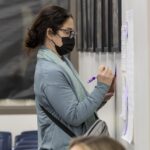
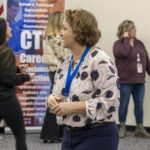
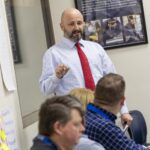

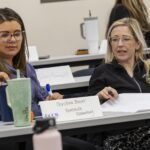
More than 40 educators from across Western New York recently gathered at the Hewes Educational Center to explore the conditions needed for learning to be successful in schools and classrooms. The professional development session, titled “Regulation to Restoration: Building Resilient Schools,” was held thanks to a partnership between Erie 2-Chautauqua-Cattaraugus BOCES and Starling Collaborative.
The two-day training demonstrated how using Restorative Practices can strengthen school communities and create learning environments where students can thrive and resolve conflict in peaceful ways. Sessions were led by Annie O’Shaughnessy, Co-Founder and Co-Executive Director of Starling Collaborative; Dr. Melissa Rivers, E2CCB Director of Instructional Support Services; Jason Mank, E2CCB Comprehensive Health Coordinator; Alycia Bongiovanni, E2CCB Coordinated School Health Specialist; and Brady Deuink, E2CCB Community Health Education Specialist.
The workshop drew a diverse group of professionals, including teachers, school counselors, social workers, administrators, and teachers on special assignments. Participants represented Jamestown Public Schools, Dunkirk City Schools, North Collins CSD, Lake Shore CSD, and Forestville CSD. Staff from various E2CCB programs, particularly the Baker Road Educational Center, CAM P-TECH, Maple Academy, North Collins, and WNY P-TECH, were also in attendance.
Mank noted that while Restorative Practices have existed for some time, the training aimed to provide a foundational understanding of building school communities while dispelling myths that can hinder the work. “There was a lot of positive engagement throughout,” Mank said. “People sharing their ideas, their expertise. We intentionally included time for teams to plan how they will implement Restorative Practices individually and at the building level. And what we really enjoyed was the cross-collaboration, hearing different voices from other districts about what their schools are doing. It’s invaluable, because so many times we can get lost in silos.”
A primary goal was for attendees to walk away with tools they could implement immediately to benefit both students and staff. Long-term, Rivers wants the work to be sustainable and replicable across the region and answer the questions: “Are we seeing less discipline issues in the hallway? Are we looking at fewer referrals coming out of classrooms? Are we trying to improve attendance? What is it that we want to work on, how are we going to do it and how do we support them in that process? Hopefully, as a result, other districts will say, ‘You know what? We really need to see what they’re doing because it seems to be working. We’re hopeful that we’ll see positive impacts from within schools with both students and with staff.”
The workshop is part of a broader initiative funded through the work of E2CCB’s Communications & Development team. Thanks to a Bureau of Justice Assistance grant awarded in November 2024, training is offered to participating E2CCB component districts at no cost.