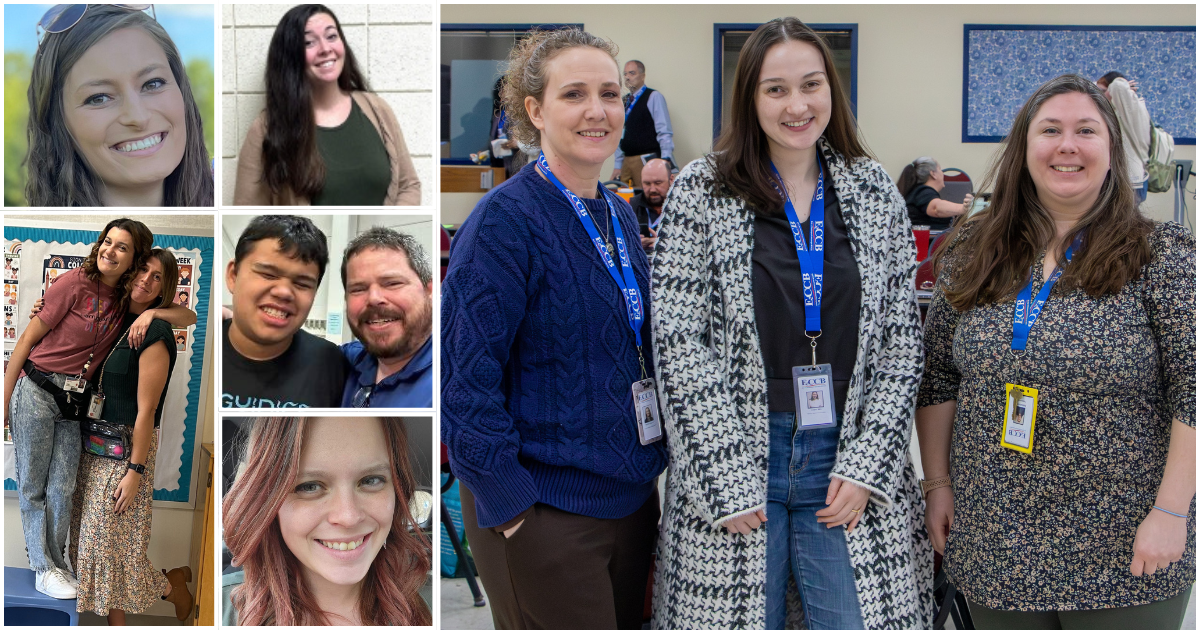
Erie 2-Chautauqua-Cattaraugus BOCES is recognizing its behavior support specialists on World Behavior Analysis Day, March 20, for the work they do to help students build communication skills, independence and confidence in school and daily life.
The team works with students, staff and families to reduce barriers to learning and create supportive environments where students can succeed.
Geoff Hopcus, E2CCB’s Behavior Support Coordinator, said the team’s work is rooted in helping students meet the same expectations as their peers while receiving the support they need along the way.
“It’s not about giving them a smaller mountain to climb; it’s about giving them the hand they need to help get up the same mountain everyone else is climbing,” Hopcus said.
He added that the behavior support team is “very passionate about supporting students” and focused on “helping to build capacity with staff so students can reach their full potential.”
For many of E2CCB’s behavior specialists, the field became personal long before it became professional.
Jarrod McEntarfer said his interest in behavior analysis grew after one of his children was diagnosed with Autism Spectrum Disorder and began receiving applied behavior analysis services.
“I was immediately impressed with its success and my child’s progress,” McEntarfer said.
What began as a way to better support his son eventually became a new career path. At E2CCB, he said, he found an opportunity to remain in schools while pursuing a field that continues to inspire him.
“Becoming a behavior specialist at BOCES was exactly what I needed to explore this new horizon as a career,” he said.
Others were drawn to the work through direct experience helping students reach important milestones.
Brenna Litwinski said she “immediately fell in love with the field” while working one-on-one with a child in a home setting. She said the work showed her how meaningful progress can be, whether that meant helping a student “speak their first words,” learn to “independently wash their hands,” or communicate more effectively.
“Being able to teach individuals anything from washing their hands to learning to functionally communicate was very rewarding for me,” Litwinski said.
She said the moments that stay with her most are seeing “the smile and excitement on my students’ faces when they accomplish a task that took them so long to learn.”
That same commitment to student growth is what drew Mikayla Poniatowski to the field.
“I’m passionate about creating positive, lasting changes in individuals’ lives,” Poniatowski said.
She said her role allows her to “advocate for and implement programs that help kids achieve their full potential,” while also working to “promote social inclusion” and empower students “to be as independent as possible.”
“It’s not just about the interventions in ABA,” she said. “It’s about contributing to a wider societal shift towards more supportive, inclusive environments.”
Several members of the team said they discovered behavior analysis after first pursuing work in education and student support.
Heather Eckstrom said she was studying teaching in college when she interned in a behavioral classroom and found that, “while challenging, I greatly enjoyed the students I was working with.”
That experience led her to change direction professionally and pursue behavioral analysis.
“I am dedicated to helping children grow and reach their goals, despite challenging behaviors,” Eckstrom said.
Jessica Hovey said she also began in education before being introduced to ABA while working in special education. What stood out to her, she said, was that “ABA is a vast field and focuses on socially significant outcomes for individuals.”
“The focus of social significance provided a different outlook,” Hovey said, noting that supports are individualized for each person receiving services. “ABA is client focused, which is why I love the field.”
For Danielle Hall, the value of the work is found in the progress students make over time.
Hall, who began working with students with developmental and intellectual disabilities in 2010, said she was motivated by “the measurable progress they were able to make — including becoming more independent.”
She added that behavior analysis can be used effectively “in a variety of settings,” including “schools, in the community, in-home.”
Amber Meli said her path into the field developed after years of working with students with disabilities in different roles.
“Behavior Analysis seemed like the natural path for me,” Meli said.
After seeing students struggle with daily tasks and behavioral challenges, she said she wanted to better understand how to help them learn those skills.
“I applied to an ABA program on a whim and haven’t looked back,” she said.
Brandy Smouse said she found behavior analysis “kind of by accident” while searching for new ways to support her students. What began with one strategy gradually expanded into a deeper interest.
After attending a conference focused on autism supports, Smouse said, “I was hooked.”
“I had to know more and I had to do more because there was this whole other option for support that was not being provided to my students,” she said.
Together, the stories reflect a team focused on helping students make meaningful gains — whether that means speaking first words, learning daily routines, communicating needs or participating more fully in school and the community.
On World Behavior Analysis Day, E2CCB is celebrating the behavior specialists whose work helps make that progress possible.